Sildenafil has been around long enough to gather a reputation, part locker-room joke, part late-night ad jingle. What gets lost in that noise is that it’s one of the more thoroughly studied drugs a person can take, with a safety story that’s much narrower and more specific than the reputation suggests. This piece lays out what the evidence shows, plainly, and where the one real caution sits.
What sildenafil actually is
Sildenafil is not a supplement or a wellness product dressed up in medical language. It received FDA approval on March 27, 1998, as the first phosphodiesterase type 5 (PDE5) inhibitor for erectile dysfunction, and the same compound is separately approved, under a different brand name, for pulmonary arterial hypertension [1]. That’s a full drug approval, tested against the kind of scrutiny regulators apply to anything claiming a physical effect on the body. The patent expired years ago, which is why generic sildenafil citrate is now widely available and inexpensive.
How it works, and what it doesn’t do
The mechanism is straightforward once it’s laid out. Arousal triggers nerves in the penis to release nitric oxide, which raises a molecule called cyclic GMP. Cyclic GMP relaxes smooth muscle in the blood vessel walls, blood moves in, and an erection follows. An enzyme called PDE5 normally breaks that cyclic GMP down again, which is why an erection fades. Sildenafil blocks PDE5, so cyclic GMP lingers longer and the relaxed vessels stay that way [1].
There’s a quiet but important detail hiding in that description: sildenafil doesn’t create arousal. It lowers the physical barrier to an erection once arousal is already happening. The nitric oxide signal still has to start somewhere. That’s worth knowing before starting the medication, since some disappointment with it traces back to expecting a switch to flip on its own.
The trial evidence, without the spin
A systematic review of randomized controlled trials found that men taking sildenafil were 3.57 times as likely to report improved erections as men on placebo, with a number needed to treat of about two [2]. A number that low is unusually strong for any medical intervention. The review’s authors also added an honest caveat worth keeping: trial participants often had some baseline erectile function already, so in men with more severe dysfunction, the real number needed to treat is probably higher [2].
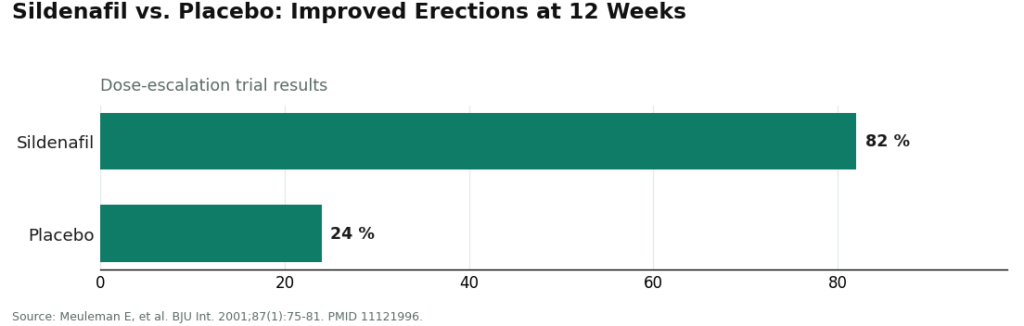
A separate dose-escalation trial designed to test both efficacy and safety found that 82 percent of men on sildenafil reported improved erections at twelve weeks, compared with 24 percent on placebo, with benefits extending across erectile function, orgasmic function, and overall satisfaction, and those gains held at 26 weeks [3].
The longer-term picture holds up too. A multicenter study followed nearly a thousand men on flexible-dose sildenafil for four years. At every yearly check, more than 94 percent still reported satisfaction and improved ability for sexual activity, with no sign that the drug’s effect wore off over time. Serious treatment-related side effects requiring a dose change or discontinuation occurred in fewer than four percent of that group [4].
Three numbers worth holding onto
If none of the rest sticks, these three do the job: 3.57, how many times more likely improvement was versus placebo. 2, the number needed to treat, a figure most treatments would envy. 94 percent, the share of men still satisfied after four years of use. Together they describe a drug that works, works well, and keeps working.
The one real caution
None of this means sildenafil is risk-free for everyone. It has exactly one serious, well-documented danger, and it involves nitrates.
Nitroglycerin and related medications for chest pain, isosorbide dinitrate or mononitrate for angina, and recreational inhalants known as poppers all work by donating nitric oxide to widen blood vessels. Sildenafil works on that same pathway. Combine the two and blood pressure can drop to a severe, dangerous degree. FDA labeling lists nitrate co-administration as a contraindication, and clinical references describe the interaction plainly: taken together, the two act synergistically to cause severe, life-threatening hypotension [1]. A joint expert consensus document from the American College of Cardiology and American Heart Association exists specifically to help clinicians navigate this risk in patients with heart disease [5]. The practical guidance that follows: a nitrate shouldn’t be taken within about 24 hours of sildenafil, roughly five half-lives of the drug [1].
This is the one place where sildenafil stops being simple, and it’s exactly why the question a prescriber asks before writing the prescription matters more than the price of the pill.
Why the screening step is the actual product
Put those two facts side by side. The drug itself is remarkably well-proven, and its one serious risk is fully mapped and entirely avoidable, as long as somebody checks. That flips the usual logic people bring to buying medication online. The cheapest option, particularly from a site that skips the prescription step, is often the one where nobody asks whether a person carries nitroglycerin or uses poppers. That’s the one part of this that genuinely shouldn’t be skipped.
What matters, then, is not finding the lowest price but finding a route where a licensed clinician actually reviews a person’s health history and medication list before anything ships, and where the medicine itself comes through a licensed pharmacy. A physician-supervised telehealth provider such as FormBlends is structured around that review step. For a drug whose risk profile is this narrow and this well-defined, that screening is the whole point.
The short version
- The one real caution with sildenafil is nitrates, full stop [1][5].
- The FDA approval is real and complete: March 27, 1998, first PDE5 inhibitor for ED, also approved for pulmonary arterial hypertension [1].
- The mechanism is modest by design. It lowers the barrier to an erection given arousal; it doesn’t manufacture desire [1].
- The trial data is strong: 3.57 times more likely to improve than placebo, number needed to treat around two, with the honest note that severity affects the numbers [2].
- The effect lasts. Four-year data shows over 94 percent satisfaction with no drop-off, and individual trials show roughly 80 percent improvement against about a quarter on placebo [3][4].
- Because the drug itself checks out, the only thing left to get right is the screening step before the prescription is written.
Questions people ask
Does sildenafil work without arousal?
No. It lowers the physical barrier to an erection but doesn’t generate desire by itself. It works by keeping cyclic GMP around longer once the nitric oxide signal from arousal has already started [1]. That’s why some people feel it “did nothing,” when really the drug had no arousal signal to work with.
How effective is sildenafil for erectile dysfunction?
Quite effective. A systematic review of randomized trials found men on sildenafil were 3.57 times as likely to report improved erections as those on placebo, with a number needed to treat of about two [2]. The honest caveat is that the real-world figure runs higher in men with more severe dysfunction, since trial participants often started with some baseline function [2].
Why can’t sildenafil be taken with nitrates or poppers?
Both act on the same nitric oxide pathway that widens blood vessels, and combining them can send blood pressure down to dangerous levels. FDA labeling names nitrate co-administration a contraindication, and clinical guidance describes the combination as causing severe, life-threatening hypotension through a synergistic effect [1][5]. This includes nitroglycerin, isosorbide dinitrate or mononitrate, and recreational poppers.
Does sildenafil stop working over time?
No, it holds up. A four-year study of nearly a thousand men on flexible dosing found more than 94 percent still reported satisfaction and improved sexual function at every yearly check, with no sign of tolerance developing [4]. Serious side effects requiring a dose change occurred in fewer than four percent of that group [4].
Is it safe to order sildenafil from a no-prescription overseas site?
The molecule is well-studied and the patent is long expired, so cost isn’t really the issue. What matters is whether a licensed clinician reviews health history and current medications first, and whether the drug comes through a licensed pharmacy. A physician-supervised telehealth route such as FormBlends is built around that review step, and for sildenafil, that step is the one part worth never skipping.
References
- Smith BP, Babos M. “Sildenafil.” StatPearls. NCBI Bookshelf, updated 2023. Confirms FDA approval on March 27, 1998 as the first PDE5 inhibitor for erectile dysfunction and approval for pulmonary arterial hypertension, describes the PDE5 and cGMP mechanism, and states that coadministration of sildenafil with nitrates is contraindicated due to the risk of severe life-threatening hypotension. https://www.ncbi.nlm.nih.gov/books/NBK558978/
- Burls A, Gold L, Clark W. “Systematic review of randomised controlled trials of sildenafil (Viagra) in the treatment of male erectile dysfunction.” Br J Gen Pract. 2001;51(473):1004-1012. Men on sildenafil were 3.57 times (95% CI 2.93 to 4.43) as likely to have improved erections as those on placebo, number needed to treat about two, with the caveat that real-world NNT is higher in more severe dysfunction. PMID 11766850. https://pubmed.ncbi.nlm.nih.gov/11766850/
- Meuleman E, Cuzin B, Opsomer RJ, et al. “A dose-escalation study to assess the efficacy and safety of sildenafil citrate in men with erectile dysfunction.” BJU Int. 2001;87(1):75-81. 82% of men on sildenafil reported improved erections at 12 weeks versus 24% on placebo, with significant gains across erectile function, orgasmic function, intercourse satisfaction, and overall satisfaction. PMID 11121996.
- McMurray JG, Feldman RA, Auerbach SM, et al; Multicenter Study Group. “Long-term safety and effectiveness of sildenafil citrate in men with erectile dysfunction.” Ther Clin Risk Manag. 2007;3(6):975-981. 979 men over four years with flexible dosing; at each yearly assessment more than 94% reported satisfaction and improved ability for sexual activity, with no evidence of tolerance or loss of effect. PMID 18516312.
- Cheitlin MD, Hutter AM Jr, Brindis RG, et al. “ACC/AHA expert consensus document. Use of sildenafil (Viagra) in patients with cardiovascular disease.” J Am Coll Cardiol. 1999;33(1):273-282. Joint ACC and AHA consensus on sildenafil use in cardiovascular disease, including the contraindicated combination with organic nitrates and the risk of profound hypotension. PMID 9935041.
How long does sildenafil actually last?
Most people get a usable window of roughly four to six hours, though the drug technically stays in the body a bit longer than that. The first two hours tend to be the strongest. A heavy, fatty meal beforehand can delay onset by an hour or more, which trips up more people than almost anything else about this drug. After six hours, the effect tends to taper off gradually rather than stop abruptly.
Can someone just take 200 mg if the standard dose isn’t working?
That’s not advisable. The FDA-approved ceiling is 100 mg in 24 hours, and going beyond it doesn’t produce double the benefit. It does meaningfully raise the risk of a severe blood-pressure drop, a prolonged erection needing emergency care, and visual disturbances. If 50 mg or 100 mg isn’t doing the job, the issue is more often timing, food, or something underlying worth discussing with a doctor, not a matter of dosage.
Does sildenafil lower blood pressure in people without ED?
Yes, it lowers blood pressure in anyone who takes it, not just those being treated for ED. For most healthy people that drop is mild and temporary. It becomes more serious when stacked with blood pressure medications, alpha-blockers prescribed for prostate conditions, or anything nitrate-based. Someone whose resting blood pressure already runs low can feel lightheaded or faint even at a normal dose, which is why a prescriber needs the full medication list, not just the ED question.
How does sildenafil actually work?
It blocks an enzyme called PDE5, which normally breaks down a molecule that relaxes smooth muscle in blood vessel walls. With that enzyme blocked, the molecule sticks around longer, vessels in penile tissue stay dilated, and blood flow increases enough to produce an erection once arousal has already triggered the initial signal. That same mechanism is why it’s also prescribed, under the brand name Revatio, for pulmonary arterial hypertension. People compounding it through a physician-supervised pharmacy like FormBlends receive that same active molecule, with the dosing accountability that supervision provides.